EADH 2026 · Kraków · September 15–19, 2026

DH as Linked Communities

A Comparison of Participants at Annual Conferences
and in Lecture Series in Germany, Austria, and Switzerland

Ulrike Henny-Krahmer ORCID and Erik Renz ORCID

University of Rostock · Rostock Working Group Digital Humanities (RosDH)

University of Rostock Rostock Working Group Digital Humanities
01

Introduction

Introduction

DH communities can be studied through presentation activity

Analyses of DH conference abstracts have become an established way of observing the field (Weingart and Eichmann-Kalwara 2017; Henny-Krahmer and Sahle 2018; Cremer et al. 2024; Haider et al. 2024; Guhr 2025).

Problem

Each of these approaches captures only one segment of DH as an interdisciplinary research field.

Introduction

Lecture series add another perspective

Conference data

Public, contribution-based, often collaborative.

Lecture series data

Invitational, often local, connected to institutional contexts.

Our contribution combines DHd conference data with data on DH lecture series in Germany, Austria, and Switzerland.

Introduction

How are DH communities linked through people?

Conference
community
Overlap
bridge
Lecture-series
community

The central aim is to define the overlap between conference contributors and lecture-series speakers, drawing on Patrick Sahle’s model of overlap, bridge, and independent area ("Schnittmenge, Brücke und eigenständiger Bereich”, 2015).

02

Data

Data

Two datasets, one comparative perspective

DHd conference data

Contributions from 2016–2020 and 2022–2025.

Lecture-series data

30 fully documented DH lecture series.

Data

DHd conference data

  • Data were retrieved from DHd’s GitHub organization.
  • Included years: 2016–2020 and 2022–2025 (9 conferences in total).
  • No TEI/XML or standardized metadata are available for 2014–2015.
  • No data are available for 2021.
  • Metadata were extracted from CSV and XML files.
  • Authors were extracted for each individual contribution.
Data

Lecture-series data

2016–2025
coverage period; 2021 excluded to align with DHd data
30
lecture series included in this analysis
783
lectures in the analyzed lecture series
722
distinct speakers in the analyzed lecture series
Dataset

Henny-Krahmer, Ulrike, Fernanda Alvares Freire, and Erik Renz (2025a). Lectures That Link. Software and data. Rostock: Zenodo. DOI: 10.5281/zenodo.15769950

Related article

Henny-Krahmer, Ulrike, Fernanda Alvares Freire, and Erik Renz (2025b). "Lectures that Link: Analyzing European Lecture Series as Nodes of Interaction in the Digital Humanities." magazén 6 (2). DOI: 10.30687/mag/2724-3923/2025/02/001

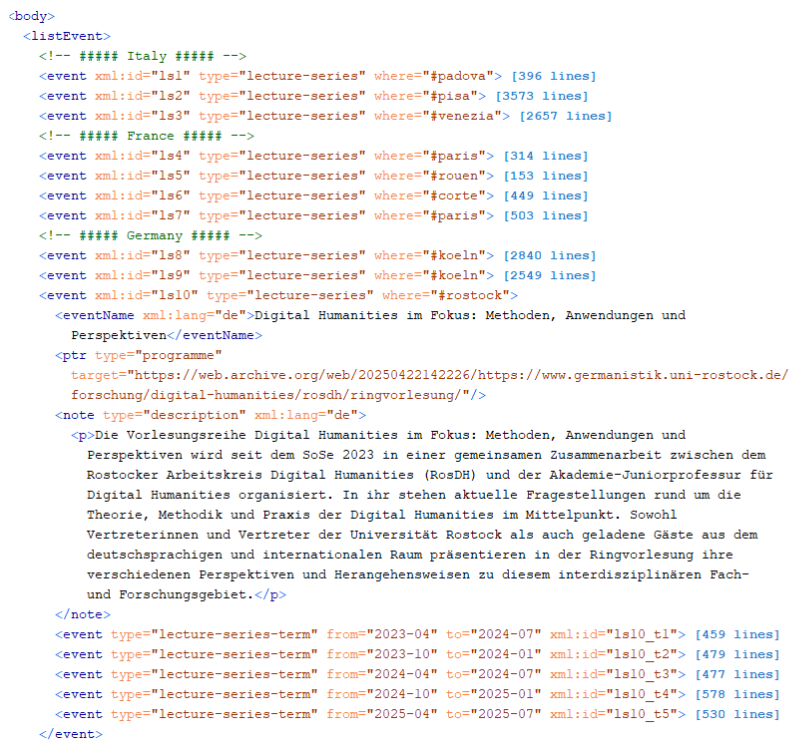
XML excerpt showing lecture series grouped by country within the listEvent element
Excerpt from the <listEvent> element: lecture series grouped by country and the beginning of the Digital Humanities im Fokus structure (University of Rostock).
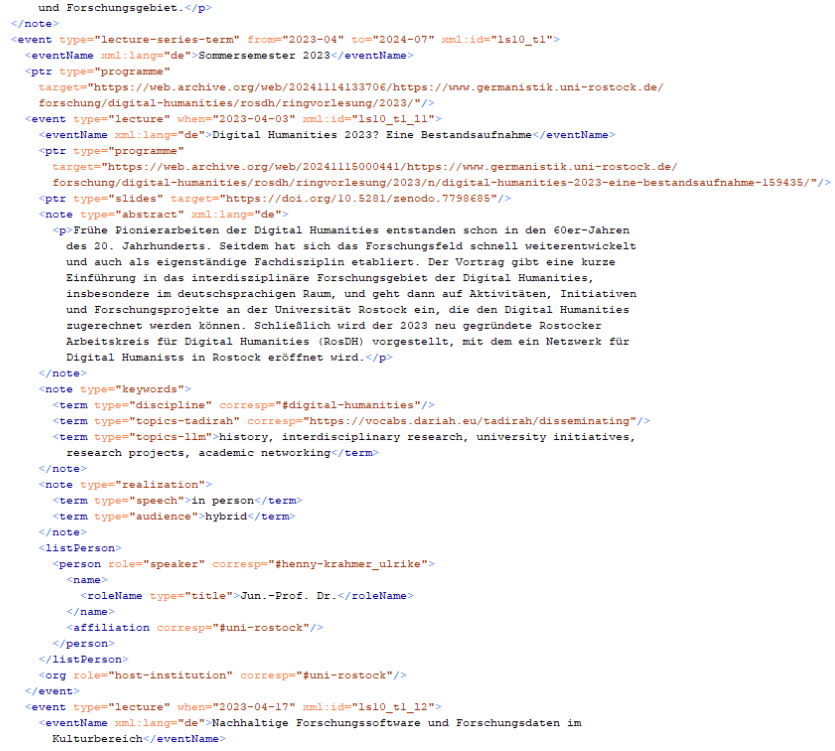
XML excerpt showing an encoded lecture from the summer semester 2023
XML-encoded lecture from the 2023 summer semester in the Digital Humanities im Fokus series.
Data

Matching people is the central data problem

ORCID IDs
where available
→
Wikidata IDs
existing or new
→
Name matching
last name, first name
→
Manual checks
variants and changes

Conference contributors have only been identified via ORCID IDs since 2022, and only when researchers provided this information in ConfTool.

03

Analysis of Contributions to DH Conferences and Lecture Series

Analysis

The two formats differ strongly in scale

1,263
conference contributions
1,983
distinct DHd contributors
783
lecture-series presentations
722
distinct lecture-series speakers

Multiple authorship is common at conferences, while lecture-series events are usually delivered by a single speaker.

Analysis

Most people appear only once

DHd conferences

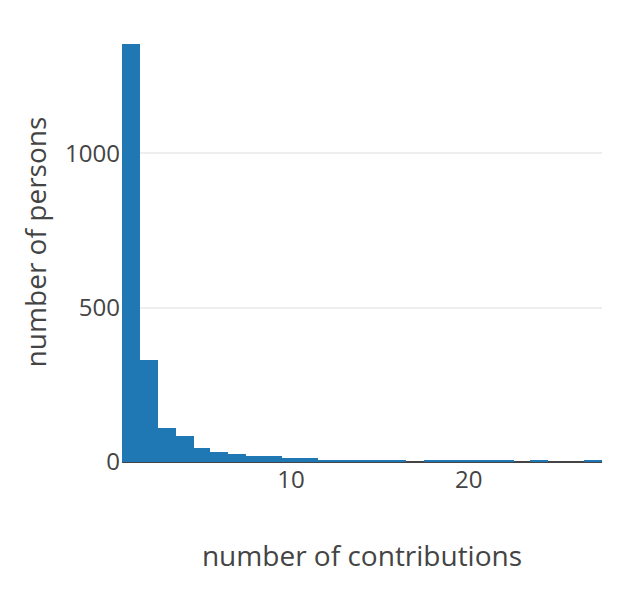
64% of contributors are involved in one contribution. 16% of contributors are involved in two contributions. The observed maximum is 27 contributions by one person.

Lecture series

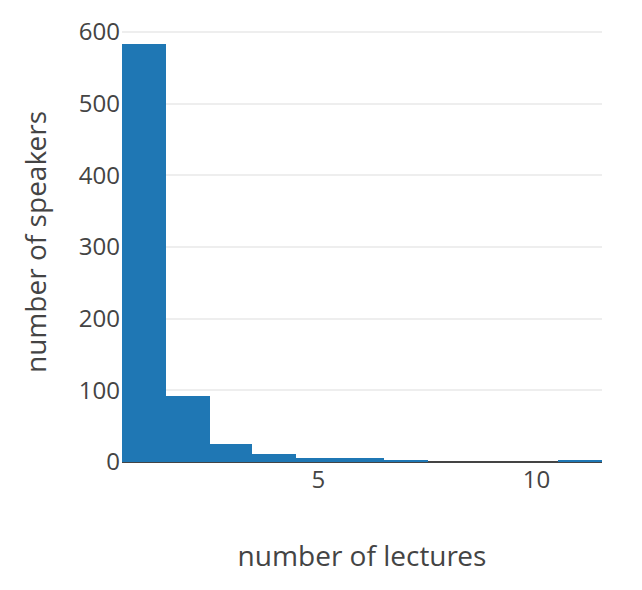
81% of speakers deliver one lecture. 13% of speakers deliver two lectures. The observed maximum is eleven lectures by one person.

Multiple participation is somewhat more pronounced in the conference context, but the overall distribution patterns are broadly comparable.

Number of contributions per person at DHd conferences Number of lectures per speaker in lecture series
Number of contributions per person at DHd conferences (left) and number of lectures per speaker in lecture series (right)
Analysis

How strongly are the two subcommunities linked?

86%

of DHd contributors do not appear as speakers in the lecture-series dataset.

277

people are visible in both contexts.

58%

of lecture-series speakers have not contributed to a DHd conference.

Analysis

A linkage score describes relative emphasis

linkage score = conference proportion / lecture-series proportion

Values above 1

stronger relative focus on conference contributions

Values approaching 0

stronger relative emphasis on lecture-series presentations

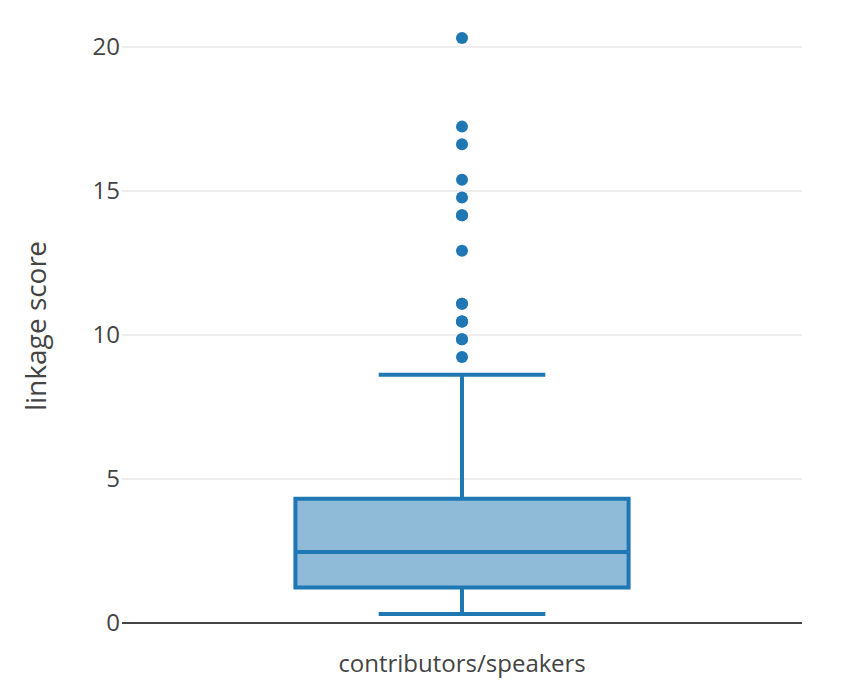
For the 277 people represented in both datasets, the median linkage score is 2.5.

Distribution of linkage scores for DHd contributors and speakers in DH lecture series
04

Conclusions and Outlook

Conclusions and Outlook

Lecture series may reveal parts of DH beyond conferences

The different participation patterns may reflect the different social forms of the two formats.

  • conference contributions are self-submitted
  • lecture-series talks are usually invited
  • doctoral researchers may be especially visible at conferences
  • lecture series may activate local actors
Possible interpretation

Lecture series may function as points of connection between DH and other humanities communities at local institutions.

Outlook

DH appears as both linked and autonomous subcommunities

By consolidating conference and lecture-series data, we can observe actors who are active in both settings, while also seeing separate groups that currently appear only in one context. Linking additional datasets is valuable: conference data alone show only one facet of DH communities.

overlap
bridges
independent areas
Outlook

Further work

  • diachronic analysis of changing participation patterns
  • integration of institutional affiliations and locations
  • analysis of collaborative constellations
  • gender-related analysis of speakers and contributors
  • further authority-data enrichment
  • continued documentation of lecture series

Thank you for contributing!

Fernanda Wolff
Fernanda Wolff (née Alvares Freire)
Magdalena Victoria Basedow
Magdalena Victoria Basedow (née Höft)
Charlotte Grünig
Charlotte Grünig
Helene Henriette Kamrath

Victoria Khalzova-Murken

References

Cremer, Fabian, André Blessing, Patrick Helling, Ulrike Henny-Krahmer, Kerstin Jung, and Nils Reiter (2024). “DHd Chronicles – Anreicherung und Analyse der Beiträge zu den Jahrestagungen der Digital Humanities im deutschsprachigen Raum 2014–2023.” In: Book of Abstracts – DHd2024, pp. 154–160. DOI: 10.5281/zenodo.10698356 .
Guhr, Svenja (2025). “Trends in den Computational Literary Studies bei den DHd-Jahrestagungen.” In: DHd-Blog. URL: https://dhd-blog.org/?p=22316 .
Haider, Thomas Nikolaus, Sebastian Gassner, and Malte Rehbein (2024). “Quo Vadis Fachbereiche und Schulen der DHd.” In: Book of Abstracts – DHd2024, pp. 411–414. DOI: 10.5281/zenodo.10698500 .
Henny-Krahmer, Ulrike, Fernanda Alvares Freire, and Erik Renz (2025a). Lectures That Link. Software and data. DOI: 10.5281/zenodo.15769950 .
Henny-Krahmer, Ulrike, Fernanda Alvares Freire, and Erik Renz (2025b). “Lectures that Link.” In: magazén 6 (2), pp. 127–148. DOI: 10.30687/mag/2724-3923/2025/02/001 .
Henny-Krahmer, Ulrike, and Patrick Sahle (2018). “Einreichungen zur DHd 2018.” In: DHd-Blog. URL: https://dhd-blog.org/?p=9001 .
Kirtania, Deep Kumar (2021). “Bibliometric Analysis of Open Access Digital Humanities Publications.” In: Library Philosophy and Practice. URL: https://digitalcommons.unl.edu/libphilprac/6667/ .
Renz, Erik (2025). “Aus dem Off: Ringvorlesungen und ihr Nutzen als Forschungsdatenquelle in den Digital Humanities.” In: FORGE 2025, pp. 254–264. DOI: 10.5281/zenodo.17178246 .
Sahle, Patrick (2015). “Digital Humanities? Gibt’s doch gar nicht!” In: Grenzen und Möglichkeiten der Digital Humanities. DOI: 10.17175/sb001_004 .
Spinaci, Gianmarco, Giovanni Colavizza, and Silvio Peroni (2022). “A Map of Digital Humanities Research across Bibliographic Data Sources.” In: Digital Scholarship in the Humanities 37 (4), pp. 1254–1268. DOI: 10.1093/llc/fqac016 .
Weingart, Scott B., and Nickoal Eichmann-Kalwara (2017). “What’s Under the Big Tent?: A Study of ADHO Conference Abstracts.” In: About Digital Studies / Le champ numérique 7 (1). DOI: 10.16995/dscn.284 .

Thank you for your attention 🦉